Defining Microlight Aircraft Beyond the Basics
What Is a Microlight Aircraft?
Just over 1,200 microlight aircraft are registered in South Africa, a number that surprises newcomers to the skies. That statistic anchors any serious conversation about these flying machines, which go beyond simple weight classes. The category is shaped by regulatory nuance and practical performance.
What truly defines a microlight? The answer lies in several measurable traits:
- An empty weight below 155 kilograms for single-seaters, or 175 for two-seaters
- A stall speed not exceeding 65 kilometers per hour
- A maximum of two seats, with fixed or flex-wing configuration
These figures refine the microlight aircraft definition for pilots and engineers alike. They explain why these machines feel responsive yet forgiving, and why they remain a gateway to authentic flight without the burden of heavy certification.
Microlight vs. Ultralight: Terminology Differences
The microlight aircraft definition behaves differently depending on which rulebook you open. South Africa calls it a regulated category under Part 105, with empty weight and stall speed limits that give the machine its character. America calls the same machine an “ultralight,” a term that implies a lighter footprint but actually refers to a different set of numbers.
Here is where the terminology splits:
- Microlight: the South African legal label for one or two seat aircraft with defined weight and stall characteristics.
- Ultralight: a North American label, usually for a single seat aircraft with an even lower stall speed.
The two words get swapped freely, which makes hangar conversations a spectator sport. Ask a pilot what he flies and you will hear a brand. Ask a regulator and you will hear a paragraph number. That split sits at the core of the microlight aircraft definition, and it never quite resolves itself.
Common Misconceptions About Microlights
Ask an engineer to define a microlight and she will cite stall speeds. Ask a pilot and he will describe a machine that fits around you like a well worn jacket. The microlight aircraft definition often hides the practical realities of flying one. A common misconception is that these aircraft are safer because they are slower. Slower does not mean forgiving. The aircraft demand precise control input, especially in turbulent coastal conditions around Cape Town. Weight shifts during passenger entry change stall behavior more noticeably than in larger machines.
Misconceptions persist in hangar talk:
- Microlights cannot fly cross country. False, they routinely cover 300 nautical mile legs.
- They require no formal training. False, South Africa enforces a structured license.
- Heavier pilots are excluded. False, but weight and balance calculations rule every flight.
Another assumption is that a microlight is simply a small aeroplane. The microlight aircraft definition includes operational limits that change how you plan every trip. Fuel reserves, weather minima, and payload tolerances are stricter than many pilots expect. The real challenge is not flying the machine, it is respecting its narrow envelope.
Anatomy and Key Characteristics
Airframe and Construction Materials
Take a look at any microlight’s skeleton and you will see a pragmatic arrangement of tubes. Most airframes rely on 6061-T6 aluminium, a material that balances strength with easy repair, which matters when you land on a Karoo farm. Some designs add chromoly steel for the critical stress areas, like the wing strut attachments, where a little extra weight buys safety.
Covering materials are just as deliberate. Polyester fabric tolerates UV exposure, while Dacron shrinks tightly over the frame for a smooth profile. Wing spars might use sitka spruce for elasticity or carbon fibre for stiffness, depending on the builder’s priorities. Consider this typical construction list:
- Aluminium for the main longerons
- Steel for the undercarriage brackets
- Composites for the nose cowl
The microlight aircraft definition packs these choices into a maximum takeoff weight of 450 kg, forcing every gram to serve a purpose. That constraint keeps the flying honest and the maintenance schedule short.
Wing Configurations: Fixed-Wing, Flex-Wing, and Weight-Shift
The wing is the primary factor in the microlight aircraft definition. Fixed-wing designs use rigid structures and ailerons, offering the most conventional control feel. Pilots bank and pitch using traditional sticks and rudder pedals.
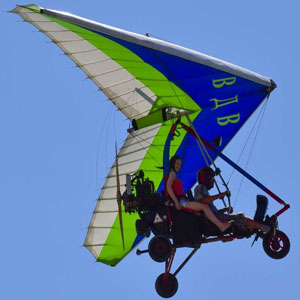
Flex-wing and weight-shift designs remove the control surfaces entirely. These aircraft hang a fabric sail above a frame, and the pilot steers by shifting body weight. This approach simplifies the mechanical load, but it demands a sharper awareness of wind conditions.
The list below breaks down how each wing type fits into the microlight aircraft definition, yet these categories often intersect.
- Fixed-wing: Provides predictable, conventional flight characteristics.
- Weight-shift: Relies on the pilot’s body weight for directional changes.
- Flex-wing: Prioritizes portability and reduces the number of moving parts.
Powerplants: Engines and Propulsion Systems
Few components shape the microlight aircraft definition as forcefully as the powerplant. A typical two-stroke engine in this class produces roughly 80 horsepower from a block you can lift with one arm. That power-to-weight ratio separates microlights from heavier recreational aircraft.
The propulsion choices break into two main families:
- Two-stroke engines: Light, simple, and inexpensive, but they require careful thermal management.
- Four-stroke engines: Heavier and smoother, with better fuel economy.
Electric propulsion is appearing at South African airfields, though range remains limited. Propeller design matters equally. Most microlights use a fixed-pitch wooden or composite prop. Some pilots choose ground-adjustable blades to fine-tune climb performance against cruise speed.
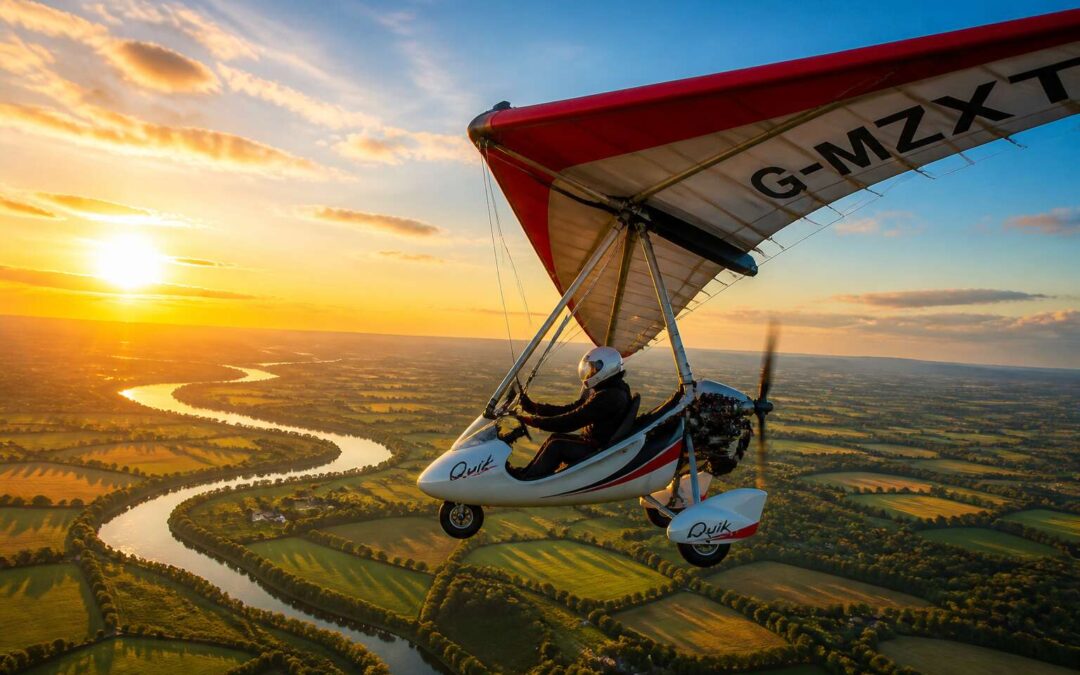
Every gram of engine weight shifts the aircraft’s centre of gravity. That is why pusher configurations dominate the market. The mass sits behind the pilot, keeping the nose light. And honestly, you will rarely find a cleaner expression of the microlight aircraft definition than a well-balanced pusher layout.
Avionics and Flight Controls
Your cellphone packs more computing power than the entire avionics suite in most microlights. That is not criticism. The panel shows airspeed, altitude, engine temperature, and a compass. Enough data to fly, not enough to distract. This restraint sits at the core of the microlight aircraft definition.
Flight controls stay equally blunt. Weight-shift machines use a bar and your own body for pitch and roll. Fixed-wing types offer a stick and rudder pedals. No fly-by-wire, no servo assists, just direct links.
- Handheld radio for talking to towers
- Small GPS unit as a map backup
- Transponder only in busy airspace
You push, the aircraft moves. That feed of pressure and response keeps flying skills sharp.
Safety Features and Emergency Systems
The anatomy of a microlight is honest. Tubes and cables do exactly what they appear to do. No hydraulic fluid, no pressurised systems. The airframe flexes in turbulence, and that flex is not a flaw. Weight matters. A machine that weighs less survives a hard landing better than one that carries excess mass. These physical limits are part of the microlight aircraft definition.
Safety arrives through restraint. A ballistic recovery parachute rides behind the pilot, waiting for the day it never hopes to meet. Emergency landings are rehearsed on the ground before they are needed in the air. You are the system. That reality is embedded in the microlight aircraft definition.
- Ballistic recovery parachute
- Four point harness
- Rollover protection structure
These elements do not advertise themselves. They sit silent and ready, checked by habit before every departure.
Payload and Range Capabilities
Payload and range define what a microlight can actually do for you. In South Africa, where airfields sit hours apart, those numbers matter. Most two seat microlights carry a useful load of around 200 kilograms. That includes fuel, baggage, and both occupants. Range follows the same logic. With a standard tank, expect three to four hours of flight time. Enough for a morning hop from Johannesburg to the Magaliesberg and back.
The anatomy of these machines rewards restraint. Every component earns its place by weight. That is the core of the microlight aircraft definition. You feel the trade offs on every climb:
– Wing loading
– Propeller pitch
– Fuel quantity
Each choice shifts the others. Add full fuel and you lose climb rate. Reduce baggage and you gain a safety margin. It is a continuous calculation, not a fixed specification. The payload you carry changes the aircraft beneath you. That is the honest physics of ultralight aviation.
Regulatory Framework and Certification
National Aviation Authority Classifications
The official microlight aircraft definition in South Africa is not a casual label. It is codified by the South African Civil Aviation Authority. This authority sets the limits that separate microlights from general aviation aircraft, and those limits affect every pilot who wants to fly one.
The certification process is where the definition becomes real. You cannot simply call any small plane a microlight. The regulator requires specific categories, and each one carries its own set of rules. Here is a practical breakdown!
- Fixed-wing microlights, with a maximum take-off weight of 450 kilograms.
- Weight-shift microlights, also capped at 450 kilograms.
- Powered parachutes, which have a distinct certification path.
Each class demands a specific pilot rating. I have seen pilots assume a microlight rating transfers across categories, but it does not. The authority inspects your aircraft to confirm it meets structural and safety standards. That is what certification truly means.
Pilot Licensing Requirements
The regulatory framework does not stop at aircraft certification. It reaches directly into the cockpit. Every pilot must hold a licence that matches the specific microlight class they intend to fly. The microlight aircraft definition in this context becomes a legal instrument, not merely a technical description.
Pilot licensing under the SACAA requires:
- A minimum age of 17 years
- A valid aviation medical certificate
- Dual and solo flight training hours
- Written examinations on air law and meteorology
- A practical flight test with a designated examiner
Every element of this process ties back to the microlight aircraft definition. I have seen pilots assume their existing licence covers every microlight category. It does not. The regulator uses that definition to decide which training syllabus applies and which examiner endorsement carries legal weight. Certification and licensing work together as a single system.
Aircraft Registration and Airworthiness Standards
The microlight aircraft definition in South Africa carries legal weight beyond simple classification. It determines which registration lane your aircraft enters. The SACAA maintains a national register that every microlight must join before flight. That register requires:
- Proof of ownership with a traceable chain of custody
- A unique registration mark assigned by the CAA
- Confirmation that the aircraft matches its type certificate or exemption
Airworthiness standards run parallel to registration. The microlight aircraft definition decides which certification basis applies to each machine. Some microlights qualify for a standard certificate of airworthiness, while others fall under the non type certificated category. That distinction changes maintenance schedules, inspection intervals, and repair facility authorisations.
Registration proves an aircraft exists on paper. Airworthiness proves it is sound in practice.
Operating Restrictions and Airspace Rules
The microlight aircraft definition in South Africa extends into the sky itself. Operating restrictions attach to the classification, not the pilot’s ambition. A machine certified as a non type certificated microlight may face altitude caps that type certificated aircraft avoid entirely.
Airspace rules compound those limits. Most microlights fly under visual flight rules, so cloud cover and visibility dictate when the engine may turn over. Controlled airspace demands a clearance, and certain restricted zones forbid entry at any time.
The classification determines:
– Maximum operating altitudes
– Minimum distance from built-up areas
– Permission to cross international borders
– Eligibility for night operations
Every one of these limits traces back to the microlight aircraft definition. That definition draws the legal boundary of your flight envelope.
Differences Between Microlights and Light Sport Aircraft
In South Africa, the distinction between a microlight and a Light Sport Aircraft often confuses new pilots. The microlight aircraft definition hinges on the certification path chosen by the manufacturer. A microlight may be issued as a non type certificated aircraft, which places the burden of proof on the builder or owner. Light Sport Aircraft, by contrast, follow a consensus standard that dictates specific design and performance parameters.
The regulatory framework treats these machines differently, even when they share similar dimensions. A microlight requires a CAA approval process that often involves a different set of maintenance schedules. Light Sport Aircraft enjoy a more streamlined administrative route, but they face their own restrictions.
Certification differences come down to three core elements:
1. The applicable design standard
2. The required inspection intervals
3. The authorised repair personnel
These factors determine whether the aircraft type is certified for aerobatic flight or limited to basic manoeuvres. The microlight aircraft definition matters most when you sell the machine or travel across provincial borders. Buyers should verify the exact certificate type before committing to a purchase. The paperwork defines your machine’s legal identity as clearly as its wingspan.
Why Fly Microlight Aircraft?
Cost-Effectiveness and Accessibility
Flying a microlight in South Africa opens a door that many assume stays shut for ordinary people. The real cost of ownership, when you include fuel, hangarage, and maintenance, often lands far below what a light aircraft demands. That is what makes the microlight aircraft definition so appealing: it captures machines designed for efficiency, not excess. I have watched first-time pilots grin after their first solo.
Accessibility also hinges on the pilot community. Clubs across the country welcome newcomers with affordable instruction and shared airfields. You can start with a simple two-seater and build hours without draining savings. The barrier is lower than most imagine!
- Lower initial purchase price
- Reduced fuel burn per hour
- Minimal storage space required
This combination lets more South Africans experience flight as a regular habit, not a rare luxury.
Fuel Efficiency and Environmental Impact
A microlight burns less fuel in an hour than a typical SUV does idling in traffic. That efficiency sits at the centre of the microlight aircraft definition. For South African pilots, this translates directly into longer flights and reduced noise.
The environmental benefits follow directly. Lower consumption reduces emissions and noise, making microlights a considerate neighbour to both nature and communities. Many modern engines run on unleaded fuel, and two stroke options have become noticeably cleaner.
Consider what this adds up to!
- Fewer litres burned per flying hour
- Smaller carbon footprint per flight
- Quieter operations at local airfields
These are practical advantages. The definition of a microlight aircraft emphasises efficiency, and that efficiency is beneficial to the environment.
The Freedom of Recreational Flying
The freedom of recreational flying becomes real at the moment of lift-off. The ground falls away, and the microlight answers every subtle input. The microlight aircraft definition often focuses on physical dimensions, but pilots know it better as an experience. In South Africa, that experience includes:
- Uncluttered views over bushveld and vineyards
- The ability to land where few other aircraft can
- A direct connection between your hands and the sky
Your view is unobstructed, your speed is your own. You can follow a river, circle a koppie, or climb above a passing storm. This is not escapism, it is presence.
Community and Training Opportunities
The average microlight pilot has more friends in the hangar than on social media. That is not a statistic, but it should be. Community is the quiet backbone of this sport, especially in South Africa where airfields double as meeting spots. The microlight aircraft definition lists dimensions and weights, yet it omits the Sunday morning crowd debating carburettor jets over coffee.
Training opportunities range from structured courses to casual coaching by veterans. Many schools offer trial lessons, and clubs happily absorb newcomers. Some of the best instruction happens informally.
- Structured grade courses
- Peer mentoring programmes
- Annual safety workshops
You will find that the microlight aircraft definition becomes less relevant once you realise how much the community shapes your learning curve. Every student pilot inherits decades of collective experience, often shared with generous doses of humour.
Performance Capabilities and Limitations
The microlight aircraft definition promises performance, but the reality depends on the pilot. A typical two-stroke machine cruises at 100 kilometres per hour. That is enough to cover enormous distances across the Karoo or the Lowveld. Climb rates, usually around 300 feet per minute at sea level, demand planning. You read the terrain, the wind, and the engine temperature continuously.
The same characteristics that make microlights responsive also limit them. Gusts, crosswinds, and afternoon heat reduce margins. Most European machines carry restrictive weather limits, but South African pilots know the bushveld generates its own turbulence. Every field is viable, yet every landing is calculated.
Range and payload bound the adventure. Two occupants, minimal luggage, and about four hours. The microlight aircraft definition quantifies these limits. It cannot describe the satisfaction of flying within them.
The Evolution and Future of Microlight Aviation
Historical Development from Hang Gliders
The microlight aircraft definition owes its existence to the hang glider pilots of the 1970s. These pioneers strapped themselves to fabric wings and launched from coastal dunes. Those early flights were pure instinct! The machines had no wheels, no instruments, and no margin for error. Pilots simply ran, lifted, and trusted the wind.
By the late 1970s, inventors attached small two-stroke engines to these gliders, creating the first true microlights. The transition was awkward. Pilots had to manage thrust while maintaining weight shift control. Within a decade, manufacturers refined the design into reliable, foldable aircraft that could be trailered home.
The future points toward electric powertrains and composite airframes. Modern microlights already incorporate GPS navigation and ballistic parachutes. The next generation will likely feature hybrid propulsion and advanced stall prevention systems. The microlight aircraft definition continues to expand as technology reshapes what these light machines can achieve.
Technological Innovations in Materials and Engines
What once seemed fixed in the microlight aircraft definition now shifts with every new alloy and lithium cell. The 1980s relied on simple welded steel and dacron. Today, carbon-fibre spars and glass-reinforced composites slice weight while adding stiffness. Engines evolved in tandem; the familiar two-stroke gives way to fuel-injected four-strokes and liquid-cooled rotax units that burn cleaner and run quieter.
South African manufacturers are testing titanium valve trains and ceramic-coated pistons to withstand high heat. The next leap involves hybrid powertrains. Lightweight electric motors paired with small range-extenders could allow pilots to climb silently over the Highveld. Research into battery energy density continues, and prototype solar skins may soon supplement charge. These innovations expand performance and the microlight aircraft definition itself, blurring the line between ultralight recreation and genuine commuter travel.
Electric Microlights and Sustainability Trends
Electric propulsion is rewriting the microlight aircraft definition once more. The drone of a two-stroke engine, once common at South African airfields, is giving way to the whine of electric motors. I have watched a handful of local pilots fly short hops on battery power alone.
The gains are tangible:
- Lower operating costs per flight hour
- Reduced noise near residential airstrips
- Simpler maintenance with fewer moving parts
Sustainability trends push manufacturers toward recyclable airframes and biodegradable composites. Solar charging rigs at rural airstrips are becoming less of a novelty. Lithium sulphur cells in prototype phase could double energy density within a decade.
The practical impact on the microlight aircraft definition is simple. Aircraft become quieter, cleaner, and cheaper to operate. That changes who can fly and where they can fly. The definition expands to include a new kind of machine, one that leaves less noise and pollution in the areas it crosses.
The Growing Popularity of Microaviation
Microlight aviation in South Africa is shifting from a niche pursuit to a familiar sight above the Highveld. The microlight aircraft definition once conjured images of fragile frames and daring pilots. Today it describes a practical, accessible way to fly for recreation and sport.
Flight schools report waiting lists. Private airstrips are adding hangars. This growth follows a broader trend, as people seek relief from congested cities and crowded schedules.
- More training programmes across all nine provinces
- A healthy second hand market for well maintained aircraft
- Youth flying clubs gaining traction at school level
The future points toward deeper integration with general aviation. As the microlight aircraft definition evolves, it captures machines that are safer, more efficient, and more popular than ever before.
Career Paths and Professional Uses
According to the South African Civil Aviation Authority, microlight flight hours have grown by 18% since 2020. That growth is driving a new question: what can these aircraft do beyond Sunday joyrides? The microlight aircraft definition now includes machines used for game counting, pipeline patrol, and even crime scene photography.
Career paths are emerging:
- Game reserve anti-poaching patrols
- Aerial crop health assessments
- Power line inspections
Pilots with a microlight licence often start these roles after 100 hours of experience. The future will likely see deeper integration with commercial operations.