Defining the Microlight Aircraft
The Technical Parameters and Weight Limits
Defining a microlight aircraft comes down to numbers, not looks. The microlight meaning in South Africa follows strict technical parameters set by aviation regulations. A key figure is the maximum takeoff weight, capped at 450 kilograms for most land-based designs. That limit forces engineers to shave every gram, which explains their pared-down appearance.
Beyond weight, the stall speed must remain under 35 knots when the flaps are set for landing. The aircraft also needs no more than two seats, one for the pilot and one for a passenger. You might think payload is trivial, but these constraints shape everything from wing design to fuel capacity.
- Maximum takeoff weight: 450 kg (land) or 495 kg (amphibious)
- Stall speed: below 35 knots
- Seat count: maximum two
Understanding the microlight meaning requires seeing these limits as safety boundaries, not inconveniences. For South African pilots, exceeding any parameter voids the craft’s classification, which has real legal consequences.
Distinguishing Between Microlight and Ultralight
Here is a surprise for many aviators: in South Africa, the term “ultralight” holds a different legal meaning in the general aviation sector. The microlight meaning under the South African Civil Aviation Authority is quite specific, yet a light sport aircraft flies under a separate set of rules. These two categories often get confused, but they are distinct.
An ultralight classification typically weighs the craft in at under 115 kilograms with a single seat. This is a bare-bones machine, often a hang glider with a motor strapped to the pilot. Pilots of these machines require a different license, and the aircraft type is not subject to the same airworthiness certifications. That said, the microlight meaning for flyers is defined by the flight envelope and operational capacity. It is less about minimalism and more about structured, legal flight.
– Microlight: Max takeoff weight of 450 kg, dual seat, stall speed under 35 knots.
– Ultralight: Single seat, 115 kg empty weight, no stall speed calibration required.
The regulatory boundary for an electric microlight meaning also aligns with the weight and power restrictions, but the absence of fuel changes the payload equation. You are buying versatility with a microlight, whereas an ultralight is a pure, raw experience. The two are not interchangeable, and the paperwork for each proves it.
The Evolution of the Term in Aviation History
In the 1970s, British pilots strapped small engines to hang gliders and called the result a microlight. The name caught on. So did the confusion. The microlight meaning was broad in those early days. Anything that flew with a minimal engine and minimal structure qualified. Regulatory bodies changed that. By the mid 1980s, the Federation Aeronautique Internationale established a microlight class. The microlight meaning morphed from casual description into legal classification. The term now carries certification standards, operational limits, and licensing requirements. A crude timeline explains the drift:
- 1970s: Hang glider engines appear in Europe.
- 1980s: The term enters official aviation lexicons.
- 1990s: South Africa adopts a codified microlight definition.
That evolution stretched the original meaning. Pilots say ‘microlight’ and think of flight. Regulators hear it and think of rules. I find it amusing that one word still serves both groups.
Common Misconceptions About Microlights
In South Africa, the microlight meaning often gets muddled by what people see on YouTube. A microlight is neither a glorified kite nor a scaled down airliner. It is a specific aircraft class with defined operational characteristics.
Consider what actually separates a microlight from general aviation: the pilot sits exposed to the sky, the control feel runs direct through the airframe, and the stall speed sits forgivingly low. Many outsiders assume these machines are unsafe. The accident records tell a calmer story, particularly among trained pilots who respect weather and terrain.
The real microlight meaning lives in the flying, not in the paperwork. Once airborne, the aircraft becomes a natural extension of your senses.
- Microlights cannot fly cross country. They routinely cover 300 kilometres per leg.
- Microlights are toys. They carry serious instrumentation and transponders.
- Microlights demand no skill. The opposite holds true.
Classifications of Microlight Aircraft
Fixed-Wing Microlights vs. Flex-Wing Trikes
When you strip away the paperwork, the microlight meaning becomes clear the moment you watch one leave the ground. The two dominant forms could not differ more in character.
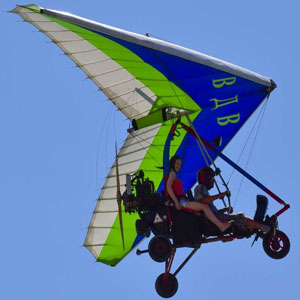
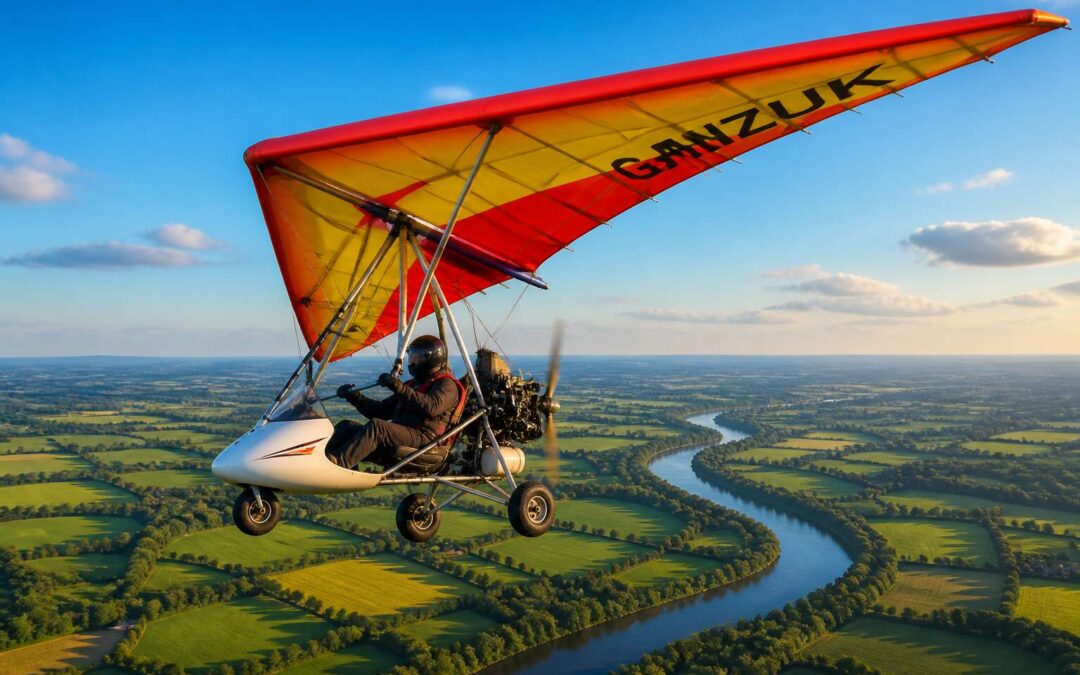
A fixed-wing microlight resembles a scaled-down conventional aeroplane. The pilot sits inside an enclosed fuselage, using a joystick and rudder pedals. It responds with precision and carries more weather tolerance. A flex-wing trike, by contrast, offers a raw experience. The wing is a fabric sail stretched over an aluminium frame, and the pilot sits exposed beneath it in a buggy-like cart. Weight shift controls the direction, no control surfaces required.
Here is how South African pilots typically choose:
- Fixed-wing for cross-country touring and radio navigation.
- Trikes for scenic flights and lower operating costs.
Understanding this split sharpens your microlight meaning because each type demands a different skill set and a different purpose.
The Role of the Rotax Engine in Modern Microlights
Few names dominate the microlight landscape like Rotax. The Austrian manufacturer supplies roughly 80 percent of the engines found on these aircraft, a figure that quietly confirms the brand’s grip on the market. To understand the microlight meaning in practical terms, one must appreciate how this engine choice shapes the flying experience.
Classifications within the sector are less rigid than newcomers expect. South African regulations group aircraft by empty weight and stall speed, not by engine type or configuration. This broad classification means a Rotax powered fixed-wing and a trike with the same powerplant share the same licence requirements, even though they handle differently. The Rotax 912 series, in particular, has become the default for its reliability at altitude, a trait that matters in Highveld conditions.
Pilots often select aircraft based on engine availability. The Rotax range offers options like the 582 for lighter trikes and the 914 for turbocharged performance. Each engine demands specific operational knowledge.
- The 582 serves entry level flex-wing pilots with simplicity.
- The 912 suits cross-country fixed-wing touring.
- The 914 handles hot and high airfields.
Knowing these distinctions clarifies the microlight meaning for prospective owners. The engine defines maintenance costs, fuel burn, and even the pilot’s skill progression. A trike with a Rotax 582 feels agricultural yet honest. A fixed-wing with a 912 feels surgical. Both fall under the same regulatory umbrella, yet the operational character could not differ more.
Single-Seat vs. Two-Seat Configurations
A microlight with one seat flies nothing like the same model with two. The wingspan, the empty weight, the fuel capacity, all scale up. Two seats add an instructor, a passenger, and a different centre of gravity. That changes the stall speed and the way the aircraft responds on landing.
In South Africa, the two-seat configuration is the training standard. Single-seat machines are lighter and cheaper to run, but they demand sharper instincts. I have seen pilots step down from a two-seat trainer and misjudge the first approach. The differences show up in three areas:
- Single-seat wings generate a snappier roll rate.
- Two-seat wings produce more lift and a slower approach.
- Payload shifts the balance and changes fuel burn.
This is where the microlight meaning becomes specific. The distinction is not cosmetic. It affects licensing, insurance, and pilot progression.
Advanced Composite Materials in Construction
Composite moulding gave microlight design a second skin, one that settles into the wind instead of fighting it. On South African airfields, I often see a two-seat fuselage built from woven carbon, not a single rivet. The microlight meaning is not just about weight anymore. It is about how the materials absorb turbulence and heat with no creaking.
There are two practical classifications in use today:
- Wet layup glass or carbon bags: resin applied by hand into the mould; it is cheaper and repairs easily, yet the thickness varies.
- Pre-preg thermoplastics: the resin is already loaded into the cloth, cured with heat under vacuum. These parts are consistent, but they need a controlled heat cycle.
That tube of difference sets the hangar schedule, the safety margins, and the price of every flight. The classification becomes the bond between builder and pilot.
Foot-Launched Powered Aircraft as a Subset
Almost every microlight flying today owes its pedals to a hang glider. Foot-launched powered aircraft started as hang gliders with a small engine strapped to the pilot’s back. That heritage still shows in the harness, the prone position, and the launch style.
The pilot runs until the wind does the rest. It is a category that strips aviation to its essentials: a wing, a motor, a pilot. In South Africa, this form appeals to pilots who want the least machinery between them and the sky. You become the landing gear.
Two configurations dominate the foot-launched market:
1. The backpack motor unit, pushing a propeller behind the pilot.
2. The trike base, where the pilot sits in a carriage with a fixed wing above.
This family of aircraft makes the microlight meaning broader. Some pilots argue these are the original microlights. Their weight and speed are modest, but the flying is direct. The term now covers machines where the pilot’s legs still matter.
Legal Framework and Licensing Requirements
European Aviation Safety Agency (EASA) Standards
More than 30,000 registered microlights currently fly under the jurisdiction of the European Aviation Safety Agency. For pilots, the microlight meaning becomes clear only through legal scrutiny. EASA standards demand specific certifications: pilot proficiency, medical eligibility, and aircraft airworthiness validation. These obligations persist beyond the runway.
A South African pilot entering European airspace must align with these rules, submitting logbooks and maintenance records without exception. The licensing pathway requires written examinations, supervised flight tests, and documented experience.
- Aircraft documentation verification
- Recurring pilot proficiency renewal
- Compliance with defined operational limits
Each step demands precision. Nothing is left to chance. Light aviation carries a substantial burden of documentation.
The FAA’s Light Sport Aircraft Rule in the United States
In the United States, the FAA’s Light Sport Aircraft rule reshapes the microlight meaning for American pilots. LSA aircraft must weigh no more than 1,320 pounds (600 kilograms) and stall at 45 knots or less. Pilots need a Sport Pilot License, which requires only 20 hours of flight time, including 15 with an instructor.
A third-class medical is replaced by a valid driver’s license. This pragmatic approach reduces barriers while keeping safety checks in place. For a South African aviator used to stricter EASA mandates, the LSA pathway feels refreshingly direct. However, each country’s regulations still demand rigorous compliance. The microlight meaning here is less about weight alone, more about aligning training and documentation with national standards.
National Variations in Microlight Certification
Ask three aviation authorities to define a microlight and you will get three different rulebooks. The microlight meaning shifts with each country’s legal framework, and South Africa is no exception. While the FAA offers the LSA route and Europe clings to EASA’s 450 kilogram limit, the SACAA takes its own path under Part 24.
Licensing requirements vary just as much. Some nations demand a full medical, others accept a driver’s licence, and a few still allow self-declared fitness. Consider the differences:
- South Africa requires an SACAA licence with dual instruction and a radio endorsement.
- Australia issues a Recreational Pilot Licence with a simple medical declaration.
- Canada uses a Permit with no formal medical at all.
That patchwork means your microlight meaning in Cape Town may not transfer to a flight school in Pretoria, let alone one in Texas. Pilots crossing borders must revalidate their credentials, a paperwork exercise that rewards patience and careful planning.
The Pilot’s License: NPPL vs. Full PPL
In South Africa, the legal framework divides microlight pilots between the National Pilot’s Licence and the full Private Pilot’s Licence. The NPPL is the standard for most microlight flyers, earned through dual instruction and a radio endorsement under SACAA Part 24. It restricts you to specific aircraft categories, yet it fits the microlight meaning of accessible personal flight.
The full PPL opens more airspace and allows heavier aircraft, but it demands more hours and a stricter medical. Many pilots earn the NPPL first, then decide whether the upgrade justifies the expense. Your training path depends on that choice:
- NPPL requires fewer hours and a shorter skill test.
- Full PPL permits night operations and larger aircraft.
- NPPL limits you to day Visual Flight Rules.
Your syllabus, your examiner, and your logbook all change with the goal. The microlight meaning extends beyond the airframe into the licence you hold.
Airspace Restrictions and Operational Limitations
In South Africa, the microlight meaning extends into the airspace you can legally enter. Microlight pilots operate under Part 24, which restricts them to uncontrolled airspace unless they hold specific endorsements. Controlled airspace near major hubs like OR Tambo remains off-limits without additional ratings.
Operational limitations shape your flying routine:
– Day VFR only, with a minimum visibility of 5 kilometres
– No flight above 10,000 feet density altitude
– No carriage of passengers for reward
These constraints are not bureaucratic quirks. They reflect the performance envelope of a light airframe and its powerplant. Understanding the microlight meaning helps you plan cross-country routes around restricted zones and weather patterns. The legal framework prioritises safety over convenience, and your logbook must prove compliance with every requirement.
Maintenance and Airworthiness Directives
Every microlight in South Africa sits inside a legal framework that extends from hangar to cockpit. The microlight meaning under Part 24 includes obligations beyond simple registration. Your aircraft needs a valid Authority to Fly, and your licence must match the correct class rating.
Licensing demands more than one flight test. You need a medical certificate, a Restricted Radio Licence, and a logbook proving recent experience. Examiners assess judgement as much as technique.
Maintenance is where pilots often falter. Airworthiness Directives from the SACAA or manufacturer carry mandatory weight. A typical inspection covers:
– Control surface hinges and cables
– Propeller condition and torque settings
– Wing fabric and stitching integrity
– Fuel system leaks and hose degradation
Each item has a specific interval. Ignoring one can ground your aircraft. I have seen it happen, and it is entirely avoidable. That discipline is part of the microlight meaning: compliance buys you the freedom to fly.
The Practical Application and Culture of Microlighting
The Thrill of Low-Altitude Flying and Cross-Country Trips
The true microlight meaning extends beyond regulations and engineering. It lives in the visceral experience of flying low over the Karoo, where ground textures become a living map. At 500 feet, you see the earth differently. Wind patterns show themselves in movement of grass. Animals react to your shadow. This is not sightseeing; it is participation in the landscape.
Cross-country trips form the backbone of microlight culture in South Africa. Pilots plan routes around weather windows, landing at remote dirt strips for breakfast, then pressing on toward the coast. Each flight demands careful fuel management, navigation by landmarks, and constant awareness of changing conditions. The community shares these journeys through fly-ins and informal gatherings, where stories of thermals and unexpected headwinds circulate freely. That practical spirit defines the microlight meaning for most of us: freedom measured in hours aloft, not kilometres logged.
Economic Efficiency and Fuel Consumption
Fuel burn on a typical two seat microlight hovers around 15 to 20 litres per hour. Compare that to a conventional light aircraft, which can easily double that figure. The microlight meaning shifts when you realise this efficiency is not a compromise, it is a design philosophy. South African pilots plan entire weekends on a single tank. Breakfast runs to distant strips, scenic loops over mountain passes, and the return leg home all fit within a modest fuel budget.
Operating costs extend beyond fuel. Hangarage, maintenance, insurance, and annual inspections all play a role. But frugal consumption remains the anchor.
– Engine oil and two stroke mix add minimal expense.
– Tyres and brakes wear slowly on light airframes.
– Routine servicing follows simple, predictable intervals.
The practical result is a form of aviation that rewards patience and planning, not deep pockets.
The Social Structure of Clubs and Fly-Ins
Sunday morning at a South African fly-in, coffee brews before the sun clears the horizon. The microlight meaning extends beyond the aircraft itself, into the community that gathers around it.
Many clubs operate from private farm strips, where senior pilots mentor newcomers on radio etiquette and weather reading. New members often receive their first passenger ride after weeks of hangar conversation, not formal introduction. A typical fly-in brings a spot landing competition, a navigation exercise, and a shared breakfast where each pilot contributes something.
The social structure works on reciprocity. I’ve seen a pilot with engine trouble surrounded by three others offering a tow rope, a spare part, and a place to stay overnight. The microlight meaning in a club context follows hours flown, not bank balance.
Emergency Procedures and Safety Statistics
Emergency procedures in microlight flying are taught with a bluntness that surprises newcomers. The culture prizes repetition over bravado. Every pilot I know runs through engine failure drills before takeoff, even on a calm Highveld morning. The statistics are sobering, but they tell a clear story. Most microlight accidents trace back to weather decisions and fuel management, not mechanical failure. That knowledge changes how pilots behave. I have watched a seasoned pilot turn back from a fly-in because cumulus clouds built faster than forecast. Nobody questioned the call.
In this community, the microlight meaning is tied directly to survival. Discipline matters more than the machine:
- Check fuel before every flight
- Confirm wind direction at altitude
- Practice simulated engine failures monthly
This practical interpretation of the microlight meaning shows up in every hangar conversation, every preflight walk, every quiet moment before start-up.
Getting Started: Training Costs and Time to Solo
The true microlight meaning extends far beyond a regulatory definition or a weight specification. For pilots across South Africa, it represents a gateway to the sky that is both accessible and profoundly challenging. The journey begins with training, a process that demands financial commitment and personal dedication. Expect to invest between R3,500 and R4,500 per hour for dual instruction with a qualified instructor. The complete syllabus, leading to your first solo flight, typically requires 25 to 30 hours of logged airtime. This places the total cost for your initial license around the R90,000 mark. It sounds substantial, but it is a fraction of the cost required to start a career in general aviation.
The cultural aspect of microlight meaning becomes tangible during your ground school and early flights. You are not just learning to manipulate controls; you are absorbing a philosophy of risk management. Your instructor will drill pre-flight inspections until the routine is second nature. You will learn to read wind direction from the behaviour of nearby trees and the surface of a dam. The decision to cancel a flight due to high winds becomes a point of pride, not a sign of weakness. This culture is supported by the clubs scattered across the Highveld and the coastal regions, where experienced pilots openly share their mistakes over coffee, ensuring that the microlight meaning is passed down as a living tradition of safety and competence.